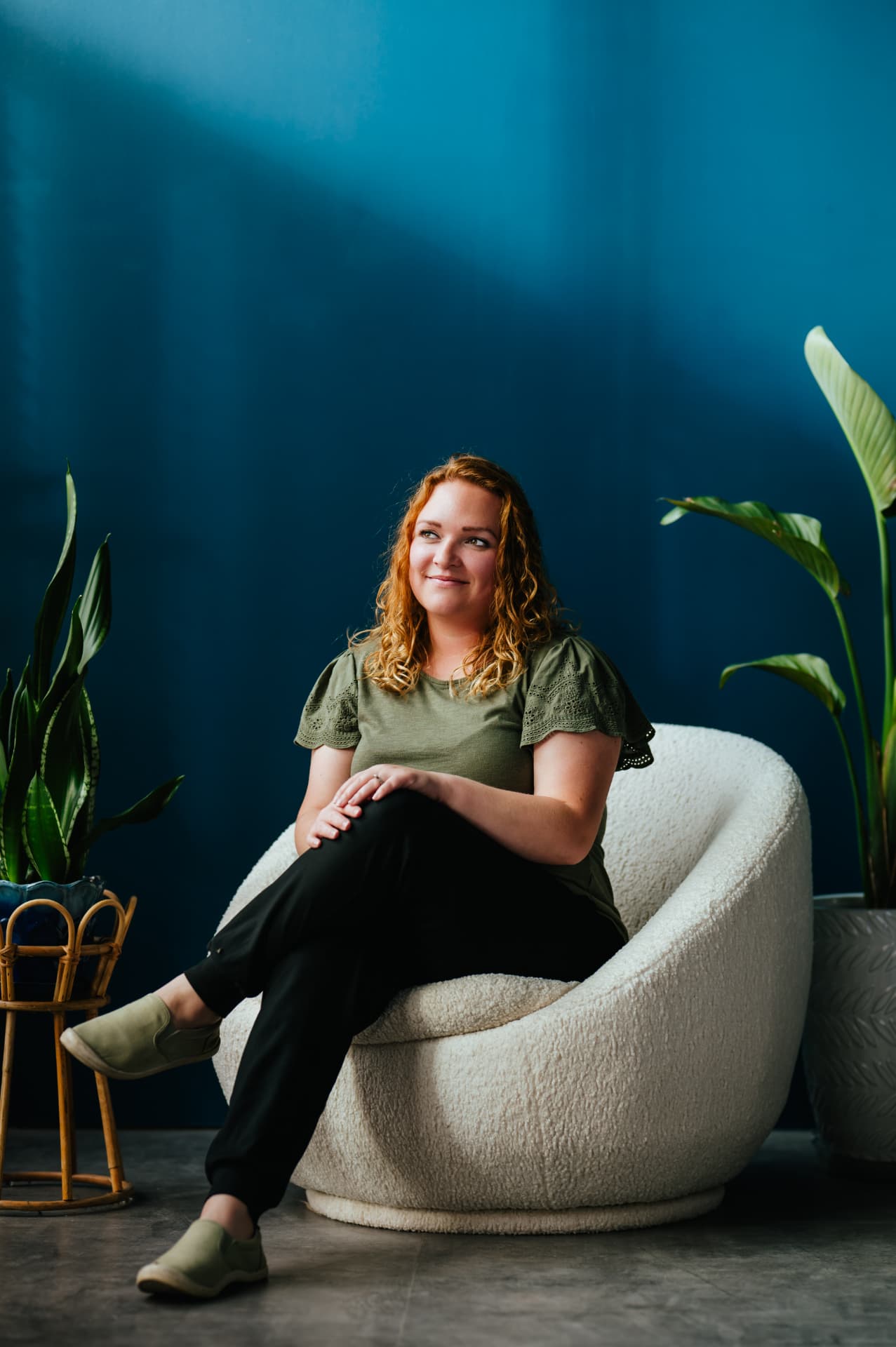
About Samantha
I believe the moment you understand what is happening inside you, you stop feeling quite so powerless.
Maybe you have spent years being told that you are too sensitive.
That you think too much. Feel too deeply. Take things too personally. Care more than you should.
Maybe you have learned how to look composed while your mind is moving a hundred miles an hour beneath the surface.
Or maybe you are the person everyone else relies on—the helper, the problem-solver, the one who keeps going—and you are quietly wondering why holding everything together has begun to feel so heavy.
If any of that sounds familiar, I want you to know something:
There is usually a reason you feel and respond the way you do.
And understanding that reason can change what happens next.
Before I had clinical language for it, I was already studying people.
I learned young how to read a room.
I noticed changes in tone. The things people said—and the things they carefully avoided saying. I could sense when something felt off long before anyone acknowledged it out loud.
People often told me I was “wise beyond my years.”
But wisdom like that does not always come from having all the answers. Sometimes it comes from learning to pay very close attention. From growing up quickly. From trying to understand what other people need, what they might be feeling, and what will help everything stay okay.
For a long time, I thought my sensitivity was a liability.
I had learned that empathy could make me vulnerable. That feeling deeply made life harder. That caring so much could be misunderstood, exploited, or treated like something I should be embarrassed by.
So, like many deeply feeling people, I tried to become more manageable.
Less affected. Less needy. Less emotional.
But our strongest qualities do not disappear simply because we learn to hide them.
Over time—and through plenty of my own healing—I began to understand that my sensitivity was not the problem. It was information. It allowed me to notice what others missed, hear what was underneath the words, and help people make sense of experiences they had never been able to name.
What I had once experienced as a weakness became one of the greatest strengths I brought into the counseling room.
Then I saw what happens when people finally have words for their experience.
I earned my master's degree in Clinical Mental Health Counseling and spent years working with people experiencing anxiety, overwhelm, depression, painful life circumstances, and patterns that made them feel stuck.
Again and again, I watched people arrive believing that they were the problem.
They thought they were weak because they could not simply stop worrying.
They thought they were failing because they understood what they “should” do but could not make themselves do it.
They judged themselves for becoming emotional, shutting down, overthinking, procrastinating, people-pleasing, snapping, avoiding, or needing reassurance.
But once we slowed the experience down, it began to make sense.
- There was a trigger.
- A thought their mind had learned to treat as fact.
- A physical response that made everything feel more urgent.
- An emotion trying to communicate something important.
- An urge that promised immediate relief, even when following it would make things harder later.
And somewhere inside all of that, there was an opportunity to choose what happened next.
I watched people visibly exhale when they realized:
There is a reason I respond this way.
I am not broken.
And I am not powerless here.
Those moments stayed with me.
I also began noticing a gap.
People were often learning these skills only after they had reached a breaking point.
Only after the emotional spiral had taken over. After the burnout. After the relationship had been strained. After they had spent years believing their emotions were problems to eliminate—or commands they had no choice but to follow.
I kept thinking: Why are we waiting so long to teach this?
- Why aren't more people learning what emotions are designed to do?
- Why aren't students being taught how thoughts, physical sensations, emotions, urges, and behaviors reinforce one another?
- Why aren't the people who spend their lives serving others being given practical ways to care for themselves before they become completely depleted?
- Why do so many of us have to enter adulthood before someone explains that acceptance is not approval, emotions are not instructions, and self-awareness is not the same thing as overthinking?
These skills should not be available only inside a counseling room.
And they should not be reserved for the moment when someone can no longer hold everything together.
That belief is what brought me here.
Today, I help people understand what they feel—and know what to do next.
I bring mental and emotional wellness education into schools, organizations, companies, conferences, and communities.
My work takes complex psychological concepts and makes them clear, human, and immediately useful.
We talk about what emotions are communicating.
- How emotional spirals begin.
- Why telling yourself to “stop thinking about it” rarely works.
- How to find the next available exit when a spiral is already gaining momentum.
- How to recognize what can be changed, what needs to be accepted, and what the moment is actually asking of you.
- How to care deeply without completely losing yourself in the process.
- And how belonging, empathy, courage, and emotional awareness can change the culture of a classroom, workplace, family, or community.
I do not believe people need another presentation filled with advice they already know.
They need language for what is happening inside them. They need tools that still make sense when emotions are high. And they need to feel like the person teaching them understands that real life is complicated.
That is what I try to offer every time I step into a room.
Not a lecture from someone standing at a distance.
A real conversation about being human.
You do not have to become less human to become more emotionally steady.
You do not need to stop caring.
You do not need to eliminate every difficult emotion.
You do not need to force yourself into positivity or shame yourself into changing.
You can learn to notice what is happening without immediately being swept away by it.
You can become curious about your emotions instead of afraid of them.
You can understand the patterns that once seemed automatic and begin practicing a different response.
You can feel deeply and still live with clarity, steadiness, and intention.
That is the work I care about.
And I would be honored to bring it to your audience.
Professional Bio
Samantha Stefaniak is a mental and emotional wellness educator, speaker, and licensed mental health counselor who helps people understand what is happening beneath their thoughts, emotions, and reactions—and what to do next.
She holds a master's degree in Clinical Mental Health Counseling and has experience supporting people through anxiety, overwhelm, emotional dysregulation, painful life circumstances, and behavior change. Samantha is known for combining clinical insight, relatable storytelling, appropriate humor, and practical strategies audiences can begin using immediately.
She offers keynotes, interactive workshops, and customized learning series for schools, companies, professional organizations, conferences, and community groups.